Color Consistency Packaging & Flexible Packaging OEM: How Global Food Brands Eliminate Color Variance Across Production Runs
Color Consistency Packaging and working with a qualified Flexible Packaging OEM are the backbones of brand equity in today’s hyper-competitive retail environment.
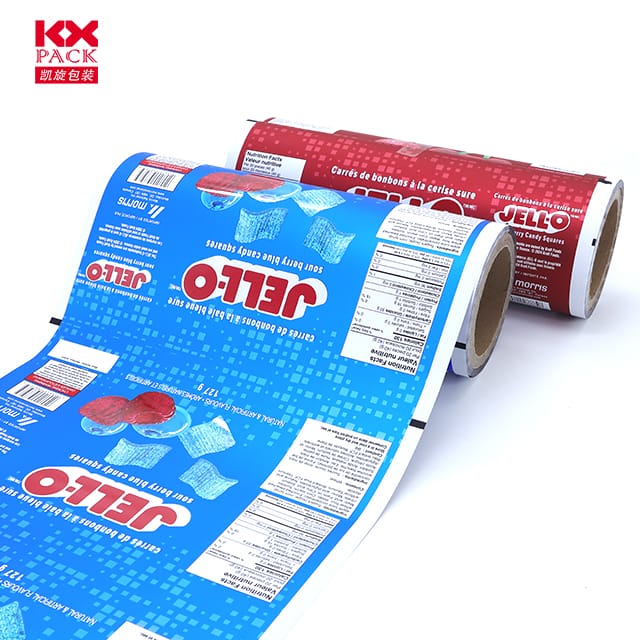
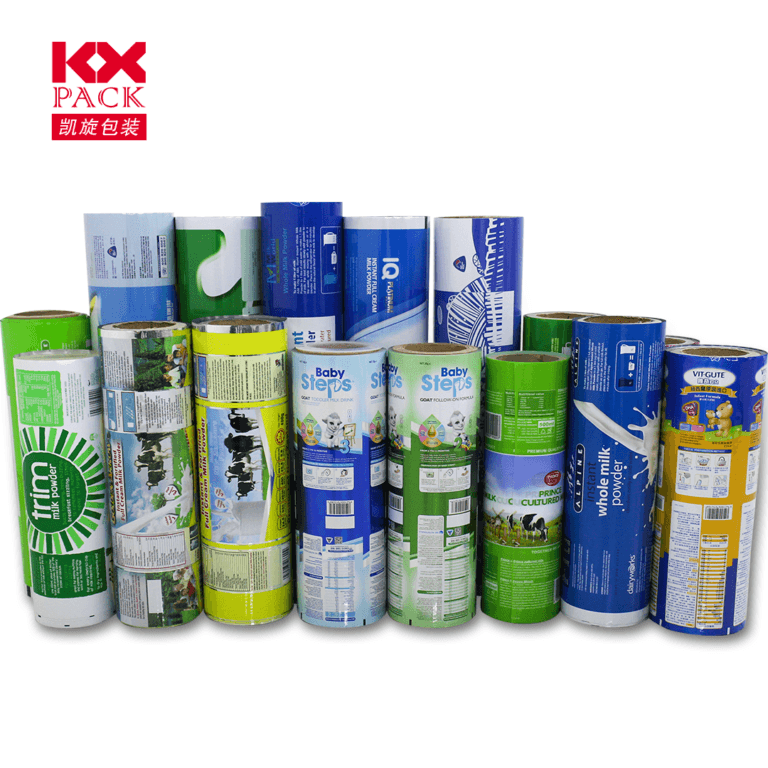
Walk down any supermarket aisle in North America or Europe, and you will notice something subtle yet powerful: high-performing food brands look identical on every shelf, regardless of where or when their packaging was produced. A bag of coffee purchased in Chicago displays the exact same rich, signature red as one bought in London or Sydney.
For international procurement managers, directori de lanț de aprovizionare, and brand owners, achieving that level of visual uniformity across global shipments is a constant challenge. Color drift, shade mismatch between batches, and poor ink adhesion do far more than hurt aesthetic appeal—they directly degrade consumer trust. When a package looks washed out or inconsistent on the shelf, shoppers instinctively question whether the product inside is a counterfeit, expired, or inferior.
Let’s explore the technical hurdles behind color replication in custom flexible manufacturing, and how partnering with an advanced OEM factory ensures your brand’s colors remain flawless across every single production run.
Why Color Drift Happens in Flexible Packaging Manufacturing(Color Consistency Packaging)
Achieving true Color Consistency Packaging across long production runs is significantly more complex than printing on standard paper or cardboard. Flexible packaging relies on multi-layer polymer films, complex foil barriers, and high-speed machinery—all of which introduce variables that can alter how color presents to the human eye.
1. Substrate Transparency and Surface Energy
Printing directly onto Polyethylene (PE), Polipropilenă orientată (OPP), sau poliester (PET) presents unique challenges. Each polymer film possesses a distinct refractive index and surface energy. De exemplu, a spot color printed on transparent PET will render differently when backed by a shiny aluminum foil layer compared to an opaque white PE film. Without precise undercoating and opacity management, the substrate will alter the top-layer hue.
2. Ink Viscosity and Solvent Evaporation
In high-speed gravure printing, liquid inks are thinned with solvents to maintain precise flow rates. As printing presses run at speeds exceeding 200 meters per minute, ambient temperature and humidity cause solvents to evaporate at fluctuating rates. If press operators fail to monitor and adjust ink viscosity continuously, the color density shifts midway through a roll, causing the first 1,000 meters of film to look visibly different from the last 1,000 meters.
3. Gravure Cylinder Wear and Engraving Depth
Gravure printing uses chrome-plated steel cylinders etched with microscopic cells that hold ink. Over massive production runs—say, 500,000 pouches—the mechanical friction between the doctor blade and the cylinder gradually wears down these cells. Shallower cells transfer less ink, resulting in a gradual loss of color saturation across large orders if the factory lacks real-time density monitoring.
4 Technical Protocols for Guaranteeing Color Consistency(Color Consistency Packaging)
To guarantee that your brand’s Pantone colors remain identical from batch to batch, an experienced Flexible Packaging OEM must implement rigorous, data-driven quality control measures rather than relying solely on subjective human visual checks.
Protocol 1: Digital Color Profiling with Spectrophotometers
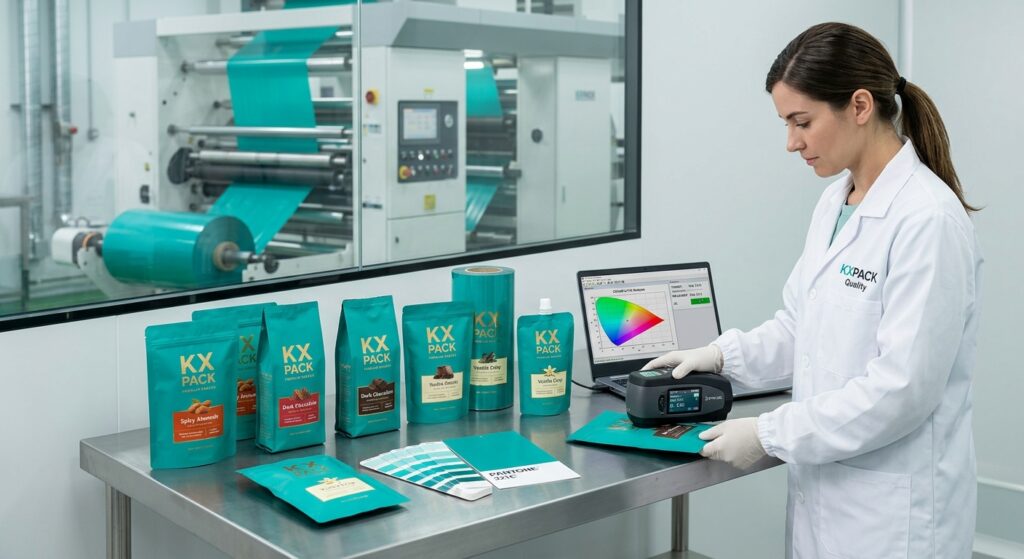
Visual comparison under standard room lighting is inherently flawed because human eyes perceive color differently based on fatigue and ambient light. Leading packaging facilities utilize industrial spectrophotometers to measure color mathematically using the CIELAB color space ($L^*a^*b^*$).
By establishing a precise digital master profile for your brand’s target colors, quality control teams evaluate color accuracy using Delta E ($\Delta E$) calculations.
$$\Delta E = \sqrt{(\Delta L^*)^2 + (\Delta a^*)^2 + (\Delta b^*)^2}$$
In professional packaging manufacturing, maintaining a strict tolerance of $\Delta E < 1.5$ ensures that any minor shade variation remains completely invisible to the naked human eye.
Protocol 2: Closed-Loop Automated Viscosity Control
Modern high-speed printing lines incorporate automated, closed-loop ink viscosity management systems. Optical sensors constantly measure ink density inside the ink pumps and automatically inject precise amounts of solvent or fresh ink concentrate to maintain equilibrium throughout multi-day press runs.
Protocol 3: Standardized Proofing & Master Swatch Sign-Offs
Before engraving permanent steel copper cylinders, a professional OEM partner provides physical drawdowns (ink proofs pulled directly on your specified substrate) alongside digital proofs. Once approved, this physical sample becomes the official Master Color Swatch, archived in climate-controlled conditions to serve as the baseline for every future re-order.
Protocol 4: Intelligent Electronic Registration and Web Inspection
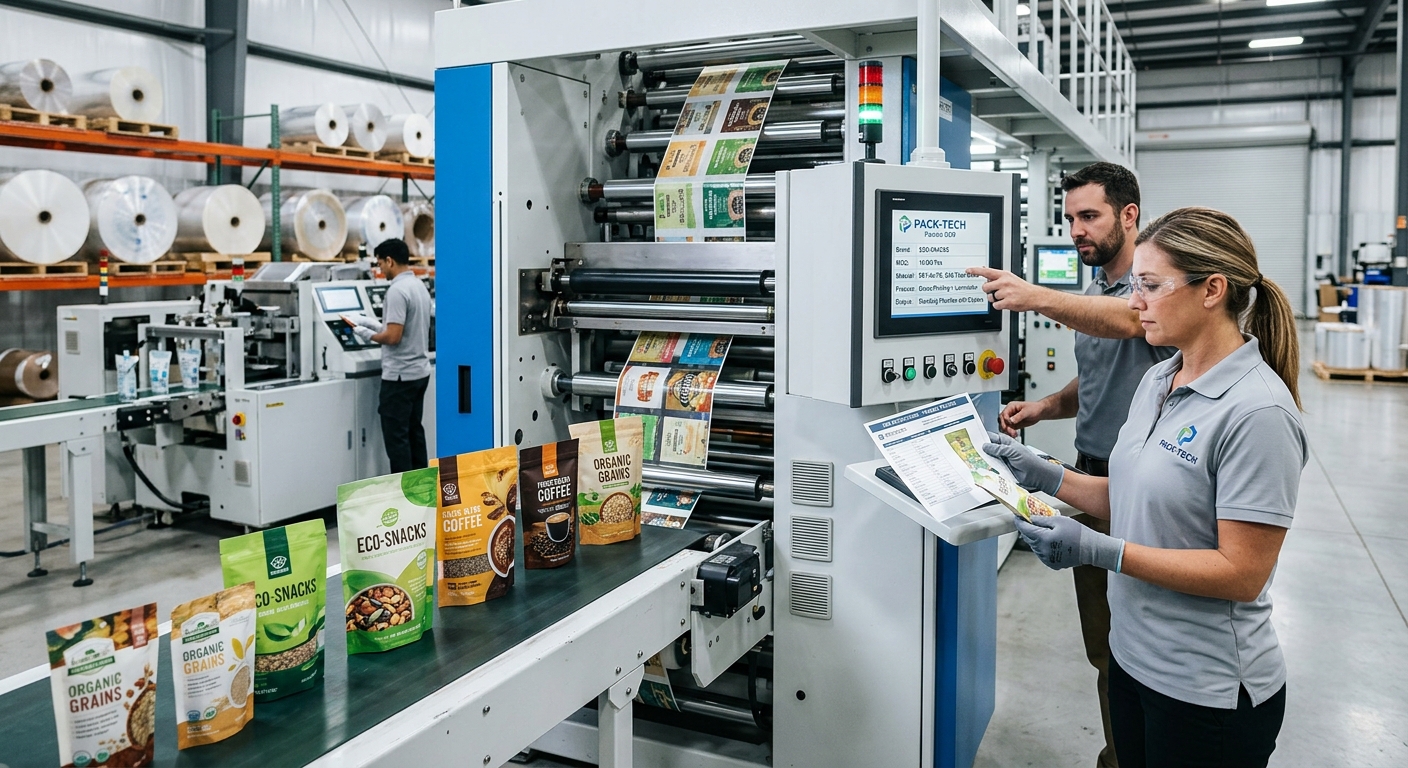
High-speed line cameras scan 100% of the moving film web during production. These automated inspection systems detect microscopic registration errors, ink streaks, or color density drops instantly, alerting press operators to make real-time corrections before non-conforming film reaches the rewinding stage.
Comparing Quality Control: Standard Suppliers vs. Advanced OEM Factories
When auditing potential flexible packaging suppliers, understanding their internal quality standards helps you avoid costly re-prints and delayed product launches.
| Caracteristică / Standard | Standard Packaging Supplier | Advanced Flexible Packaging OEM |
| Color Measurement | Visual inspection under ambient fluorescent lights | Spectrophotometric analysis using $\Delta E$ digital targets |
| Color Tolerance Limit | $\Delta E < 3.0 \text{ la } 4.0$ (Noticeable shifts on shelf) | $\Delta E < 1.5$ (Imperceptible visual variance) |
| Ink Management | Manual solvent mixing by press operators | Automated closed-loop ink viscosity control systems |
| Substrate Management | Basic corona treatment checks | Surface tension testing ($\text{dyne/cm}$) before every ink run |
| Trasabilitate | Basic lot numbers on shipping cartons | Full batch traceability linking ink lots, cilindrii, and roll codes |
The Strategic Advantage of Partnering with KXPACK(Flexible Packaging OEM)
La KXPACK, we recognize that your flexible packaging is the primary physical touchpoint between your brand and your customers. Operating as a trusted China-based OEM factory since 1997, we have spent nearly three decades perfecting high-precision gravure printing and custom film conversion for over 400 clients across more than 100 ţări.
Our integrated manufacturing capabilities ensure your packaging delivers uncompromised visual impact and functional protection:
- High-Precision Gravure Printing: Advanced multi-color presses equipped with automated registration and continuous color-density controls.
- Solvent-Less Lamination: Eliminates solvent retention and odors, ensuring your barrier packaging remains 100% food-safe and inert.
- Versatile Formats: From custom Pungi Stand-Up, Pungi cu gura de scurgere, şi Flat Bottom Coffee Bags to high-barrier Saci de vid şi Cup Sealing Films.
- Comprehensive QC Protocols: Every order is verified against archived master samples and rigorous $\Delta E$ tolerances before final conversion and shipment.
Elevate Your Brand’s Shelf Presence Today
Inconsistent packaging colors should never compromise your brand’s market position or consumer trust. Whether you are launching a new line of premium food products or seeking a reliable OEM supplier to streamline your global packaging procurement, the engineering team at KXPACK is ready to assist.
Contact KXPACK today to request a custom sample kit, submit your Pantone specifications for a technical evaluation, or receive a competitive quote on your next production run!